Reduce Friction in Philippine Flight Booking Apps by Half
User Research, UX Design
April 2024 - October 2025
Solo UX Designer

A research-driven redesign of airline booking apps in the Philippines. Removing friction, surfacing critical information, and giving users a calmer path to checkout.
Introduction
Context
The Philippines is a fragmented archipelago of over 7,600 islands, which makes air travel not just a luxury, it's often the only practical option. This project set out to identify where and why airline booking apps fail their users, and to offer a more focused, transparent, and friction-free alternative.
Problem
How might we redesign the booking flow so that travelers feel informed not overwhelmed, and be able to complete a booking confidently with minimal issues?
Solution
Create a more simplified flow, optimize ambiguous and confusing steps, so that the user will be able to book their flights easier and with zero to minimal issues.
My Role
Solo UX Designer
I worked as the sole UX Designer for this airline booking app project, leading the end-to-end design process from research and ideation to prototyping and user testing. Throughout the journey, I collaborated with my cohort peers, UX instructors, the UXDI team & community, and former colleagues who participated as user testing subjects to gather insights and refine the experience.

Research
Understanding real traveler experiences
Before designing anything, I needed to understand the landscape from the users’ perspective. Research was structured across these complementary methods to capture both the emotional texture and measurable patterns of the current booking experience.
Research Methods

Usability Testing
I conducted in-depth interviews and live usability testing sessions with three frequent travelers, observing their natural booking behavior on competitor airline apps.

Competitive Benchmark
I benchmarked the top airline apps in the Philippines against NN's 10 Usability Heuristics, evaluating the flight booking flow. This revealed systemic app issues.

User Surveys
I sent out a user survey on social media to capture quantitative data on user satisfaction, task completion confidence, and feature priorities across a broad traveler audience.
Research Findings
Users expect flight booking apps to be more forthcoming.
“Inform me outright of all details to help me make a decision. Such as lowest prices, best available dates, clear tier inclusions, etc.”
Users often miss important details while booking.
“I only realized that I was booking a trip with multiple flights at the final step. It didn't explicitly show this when it mattered.”
Users get frustrated over long & tedious booking forms.
“Why are there so much info to fill out? Can’t the app remember all of these or at least suggest known fields such as my name or my current city?”

Define
Identifying the right problems to solve
Research findings were synthesized into key themes, user needs, and business opportunities. This phase helped transform observations into clear problem statements and prioritize the areas where design could create the greatest impact.
Affinity Diagram

User Journey Map

Constraints & Trade-Offs
Every design project comes with unexpected challenges and limitations throughout the process. The ability to adapt and find practical solutions is essential in creating meaningful experiences. These were some of the key constraints identified during the problem definition phase that shaped the direction of the flight booking experience.
1. Simplified flight booking requirements.
Actual flight booking supports multiple traveler scenarios, including one-way, round-trip, multi-city flights, different passenger types, baggage options, and seat preferences. But UXDI's requirement only allows support for a single path. While defining the problems needed to be solved, I had to consider the multiple traveler personas and use cases while actually only solving for one.
2. Existing systems and local context.
The UX needed to work within existing airline reservation systems, payment gateways, third-party services and the local Philippine context, limiting flexibility in certain workflows.
Wireframes
Exploring and validating booking flows
Early concepts were translated into low-fidelity wireframes to test structure, information hierarchy, and task flows. Iteration at this stage allowed ideas to be evaluated quickly before investing in visual design.
Flight Search Steps

Passenger Details Steps

Booking Confirmation Steps


Design Solutions
Designing a faster booking experience
The final designs focused on reducing friction, improving decision-making, and building user confidence throughout the booking journey. Every interaction was crafted to balance customer needs with business goals.
Price Calendar & Proactive Fare Disclosure
TRANSPARENCY
Introduced a month-view price calendar on the search screen, allowing users to identify the cheapest travel window before selecting dates.


Explicit Connecting-Flight Indicators
CLARITY
Persistent visual indicator for connecting flights, stopovers, and total travel time displayed prominently in the card, not collapsed behind an expand button.


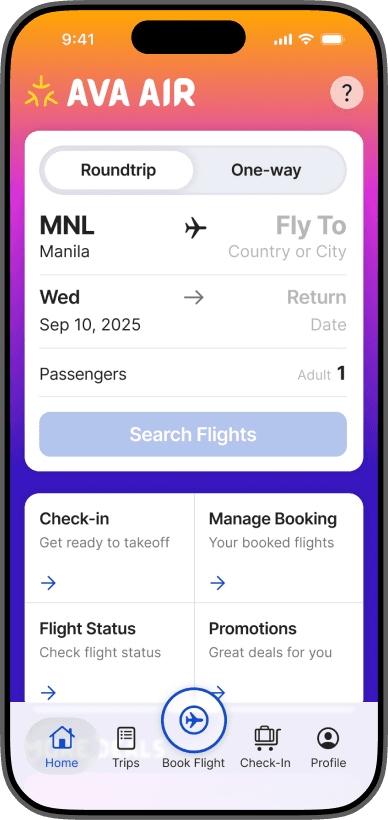
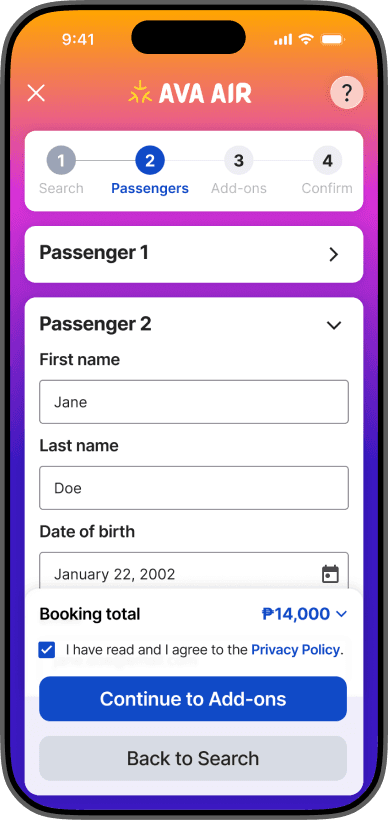
Smartly Pre-Fill Known Information
EFFICIENCY
Autofill passenger details with saved passenger profiles. The departure city field defaults to device location, and frequently completed fields (nationality, country) are prefilled as well.


Streamlined Checkout with a Clear Summary
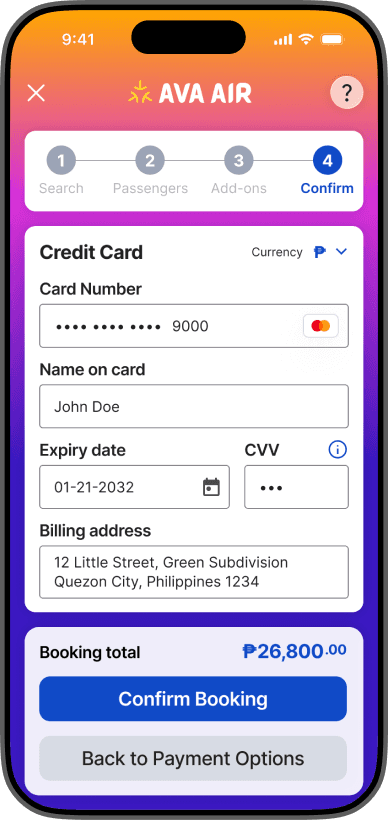
TRUST
A persistent bottom summary bar tracks the total running cost as users add baggage, seats, and meals. Eliminating the "sticker shock" moment at the payment step.
Final Designs

Success Metrics
Measuring experience and business impact
Success is defined through a combination of design and business metrics. These measures will provide a clear framework for evaluating whether the redesigned experience improved both customer outcomes and organizational performance.
Conversion Rate
2.5x
increase in overall user goal completion when booking.
Track the impact on the total number of users who complete their main goal of booking a flight.
Activation Rate
2x
target rate when leading new users to first ‘Aha!’ moment.
Track the effectiveness of the onboarding of new users to reach their first significant value in the app.
Time to Value
1/2
average time reduced from search to booking step.
Reduce friction and the time it takes from search up to passenger details or booking confirmation page.
Course Outcome
94%
overall score received in Professional UX Design Diploma.
This project served as a demonstration of the research, strategy, and design skills developed throughout the diploma program. A total of 15 modules completed, covering user research and testing, analysis, prototyping, high-fidelity design, including 10 projects submitted, and an AI fundamentals additional module.
Lessons Learned
1. What I’d do differently, if given the chance
Allow registered passengers to save an ongoing booking session including destination, desired travel dates, passenger details (including their travel companions), and be able to resume this process at a later time. This will allow them to to be able to complete a booking faster when needed.
2. Future improvements in mind
Every passenger has a different & distinct travel behavior. Unlocking this adaptability would be a game-changer for airline booking apps. For example, a backpacker would have a unique booking path compared to a business traveler. Adding AI features to cater to every use-case is something I would like to solve, if given a chance.