Grow Your Telehealth Clinic 2.5x Faster with Live Payments
User Research, Product Design, Web App Design
January - February 2022
Product Designer

Empower healthcare providers with on demand payments feature during a live consultation.
Introduction
Context
VSee Clinic app is a complete telehealth platform from VSee Health Inc. used by both enterprise customers and small clinics for their patient users.
Problem
The current payment feature is limited and not flexible enough to support changes on the fly. There’s no option to request additional payments outside of the fixed consultation fee.
Solution
Introduce a modular payment experience to allow providers to charge patients as needed. This means clinics don’t have to use 3rd party payment platforms, saving about 12% in costs.
My Role
Product Designer
I was the Product Designer leading the end-to-end design process for a payment feature release in a telehealth app, from understanding user needs and defining flows to designing, prototyping, and supporting implementation. I collaborated closely with the VP of Product, PM, business team, and engineering team to deliver a seamless payment experience aligned with user, business, and technical requirements.

Research
Understanding the clinic payment experience
Before designing the payment feature, I needed to understand the challenges patients and care teams face throughout the payment journey. Research focused on uncovering user behaviors, expectations, and friction points to identify opportunities for a simpler, more transparent, and trustworthy payment experience within the telehealth platform.
Research Methods

User Interviews
Conducted user interviews with 5 enterprise clinic providers to identify their goals, behaviors & pain points.

Customer Feedbacks
Consulted with the customer success team to get some insights on this highly requested feature.

Competitive Benchmark
I conducted a benchmark comparison with competitor apps’ payment experience.
Research Findings
Providers tend to miss charging additional services.
“Patients often cancel or reschedule consultations, and the lack of a flexible payment feature makes policy enforcement difficult, leading to business losses.”
External clinic payments can add to operation costs.
“We use a separate payment platform for our payments. While it works as a compromise, having an integrated payment experience in the Clinic app would be the best solution.”
Patients who want to pay cash don’t trust easily.
“While we are able to charge patients manually, most patients often don’t trust to give their credit card details over a call. Unless the payment invoice is sent via a secure channel.”

Define
Defining a smoother payment experience for care
Research insights were transformed into key patient needs, business challenges, and opportunities within the telehealth payment journey. This phase helped identify friction points around payment, cancellations, and transactions while defining solutions that improve convenience, trust, and operational efficiency.
Payment Flow

Constraints & Trade-Offs
Building a payment experience within a healthcare workflow required consideration of both user expectations and operational limitations. Certain business, technical, and process constraints impacted the solution approach. These were some of the key challenges identified during the problem definition phase that helped define the final design direction.
1. Payment pre-authorization flow.
A critical Stripe payment flow required clear communication with both providers and patients before processing payments. Since authorized charges may remain on hold for several days and refunds can take varying periods depending on the payment channel, the experience needed to set expectations, explain the process, and confirm user actions before completing the transaction.
2. Confirming payment during consultations.
Due to telehealth workflow limitations, payments can only be completed during live consultations, unlike traditional e-commerce experiences. Since patients may not be prepared to handle payments during a healthcare session, both providers and patients need clear guidance before scheduling, entering the waiting room, and receiving the invoice.
Wireframes
Exploring a simpler and more flexible payment flow
Early concepts were translated into low-fidelity wireframes to define the payment journey, validate key interactions, and organize information clearly. This stage focused on creating a seamless experience for patients while addressing payment flexibility, transaction confidence, and operational needs before moving into visual design.
Patient Payment Steps

Provider Payment Steps


Design Solutions
Designing a seamless payment experience
The final designs focused on simplifying transactions, improving payment transparency, and reducing friction throughout the consultation journey. Each interaction was crafted to help patients complete payments confidently while supporting flexible workflows for healthcare teams and improving operational efficiency for the telehealth platform.
Native Patient App Notification
INTUITIVENESS
Introduce a VSee Clinic app native notification module. Where patients are able to receive and track system, provider and clinic notifications even during live consultations.


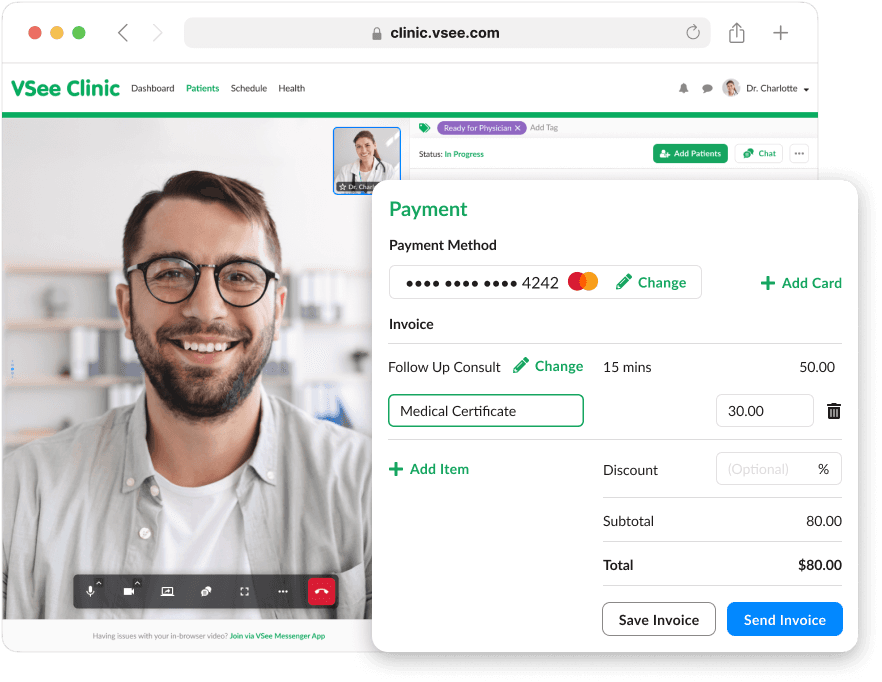
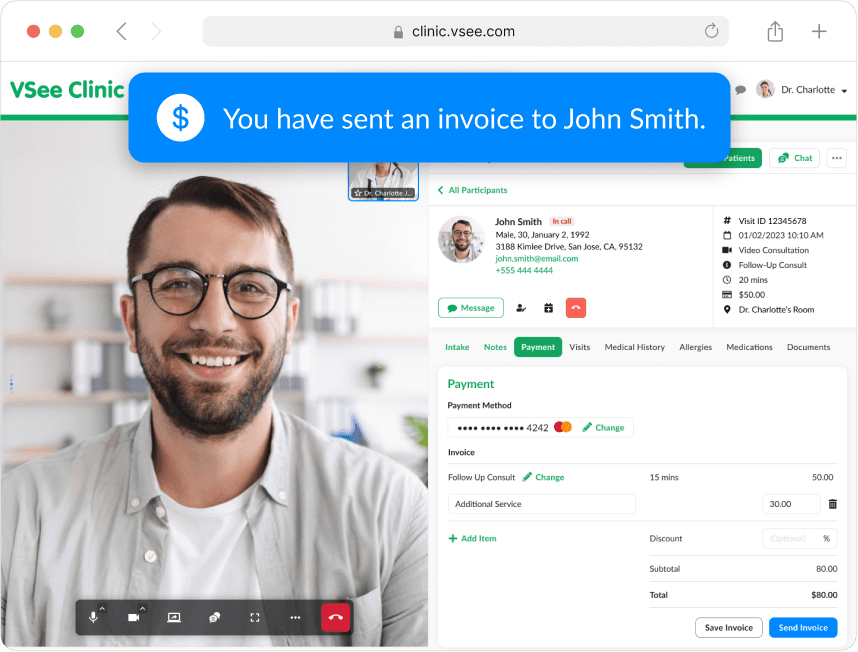
Send Invoice Feature
TRUST
Clinic providers are able to add any invoice item, and send it to the patient during a video consultation. Patients will be able to instantly accept and review all payables during and after the consultation.



Final Designs

Success Metrics
Measuring experience and business impact
Success is defined through a combination of design and business metrics. These measures will provide a clear framework for evaluating whether the redesigned experience improved both customer outcomes and organizational performance.
Customer Satisfaction
20+
positive enterprise customer feedbacks in the 1st month.
Customer success team happily reported that the enterprise customers who enabled the new payment module were mostly delighted and excited with the new features.
Feature Adoption Rate
8
new enterprise customers enabled payment feature.
The payments feature was enabled for the clinics who were requesting it, plus a few more new users. Business team was able to close new deals with the release of this new feature.
Error Rate
8.3%
rate in missed charges (down from previous 15.4%).
One enterprise customer reported that after 1 month, they rarely miss consultation charges that were cancelled. The updated payments feature made it easier to process their billing concerns.
Lessons Learned
1. What I’d do differently, if given the chance
Encourage improvements to the hardware alongside the app experience, creating a more seamless and complete product ecosystem that delivers a consistent and valuable experience for users.
2. Future improvements in mind
Maximize integration with Apple HealthKit and Google Fit API to increase engagement, support broader health tracking, and enable connectivity with a wider range of health devices beyond Welch Allyn’s ecosystem.